
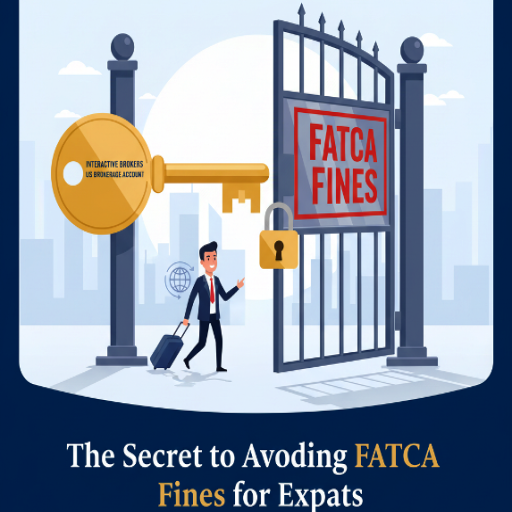
If you're a US citizen living
abroad, you know how crucial it is to keep your finger on the pulse of US
markets. Your entire strategy for Investments
& Wealth Building often hinges on maintaining a reliable US brokerage account, offering the
best fees and investment choices. The problem? That necessity drops you right
into a tax minefield, thanks to the Foreign Account Tax Compliance Act (FATCA).
This is where platforms like
Interactive Brokers (IBKR) become your most vital partner. Most US brokerages
simply shut the door on expats, but IBKR has taken on the compliance burden.
Therefore, learning to successfully manage your Interactive Brokers FATCA compliance isn't just about dodging a
penalty—it’s the single most important action you can take to protect your
capital and preserve your wealth.

Let's cut right to it: the Foreign
Account Tax Compliance Act (FATCA) was designed to catch overseas tax evaders.
The cruel irony for honest US expats is that even when your account is with a
familiar US firm like IBKR, your foreign mailing address immediately flags you
for a higher level of review and demands for complex documentation. You're
simply caught in the middle.
The penalties for getting this wrong
are severe. The IRS doesn't mess around: Wilful failure to file necessary foreign forms can trigger fines
starting at a shocking $10,000,
quickly escalating to a 40% penalty on non-disclosed assets. For detailed
information on the penalties for failure to file Form 8938, consult the
official IRS Summary of FATCA Reporting for U.S. Taxpayers.
If you're serious about Investments
& Wealth Building, protecting your nest egg means taking these
documentation requirements seriously.
Here’s the thing: the most critical
hurdle in Interactive Brokers FATCA
compliance is simply proving where you live. If IBKR can’t verify your
foreign residential address, they may be forced to treat you as a US domestic
resident for tax withholding—or, more frighteningly, they could restrict or
close your account entirely. That single administrative slip-up would instantly
sabotage your entire wealth-building strategy.
To avoid this headache, be
proactive. You need to be ready to submit specific, recent documentation, like:
One of the most confusing parts of
being an expat is figuring out the difference between the FBAR (FinCEN Form
114) and Form 8938 (Statement of Specified Foreign Financial Assets). Here’s
the good news: choosing a US brokerage
account like IBKR gives you a massive compliance advantage that directly
protects your investment portfolio right from the start.

It all comes down to the IRS
definition: The IRS explicitly states that an account maintained by a U.S. payor (which IBKR is) is NOT a "Specified Foreign
Financial Asset." Therefore, your IBKR account balance is beautifully excluded from the Form 8938 reporting
requirement altogether.
This exclusion is absolutely
critical for simplifying your wealth planning. Remember, the filing thresholds
for expats are pretty high—we're talking $200,000 at year-end or $300,000 at
any time for single filers.
By centralizing your assets in an
expat-friendly US brokerage account,
you drastically simplify the most complex FATCA reporting, freeing you up to
focus on what matters: Investments
& Wealth Building.
Even with your funds safely in a US
brokerage, you're not entirely off the hook. Because you are a non-resident for
tax treaty purposes, income—especially dividends—is still subject to withholding
tax. This is the precise point where your global wealth building intersects
with international tax treaties.
As a "US Person" (which
includes US citizens, Green Card holders, and those who pass the substantial
presence test), your obligation is to file a Form W-9 to confirm your status and provide your Social Security
Number (TIN). But here's the trick: if your country of residence has a tax
treaty with the US, you can unlock reduced withholding rates simply by making
sure your brokerage correctly identifies your true foreign residence.
Let’s look at the numbers. If you
reside in a country that has a standing US tax treaty (like Canada, the UK, or
Germany), the standard dividend withholding rate can often be slashed from the
statutory 30% down to a much
more friendly 15%.
Think of that $300 difference. That’s crucial
capital that stays invested in your US
brokerage account, compounding your wealth year after year. This
withheld tax is officially reported to you on Form 1042-S (Foreign Person's U.S. Source Income Subject to
Withholding), which you then use to claim the vital Foreign Tax Credit on your Form 1040, completely preventing you
from being double-taxed.
If there's one single enemy to an
expat's Investments & Wealth
Building strategy, it's the Passive Foreign Investment Company (PFIC)
rule. This rule is often called the "nuclear option" because it
levies devastating tax penalties on virtually any foreign-domiciled collective
investment—think foreign mutual funds or non-US-listed ETFs. The crucial
takeaway: The PFIC classification is
based on the investment product itself, not the location of your brokerage
account.

By rigorously following this one
mandate, you secure your investment capital against the single most complex and
expensive tax regime facing US citizens abroad.
Ultimately, successfully navigating
your US brokerage account while
living abroad is a masterclass in blending smart investment choices with
rigorous compliance. Interactive Brokers has provided the essential tool—the
platform—but the strategy is yours. Your action plan boils down to three core
pillars: first, diligently maintaining your foreign residency documentation;
second, smartly utilizing the Form 8938
exclusion by keeping your wealth within the US system; and third,
strictly avoiding the PFIC trap. Master these details, and you can finally
shift your focus from tax anxiety back to pure Investments & Wealth Building, ensuring your global portfolio
grows securely and efficiently.
1. Is my Interactive Brokers US
brokerage account a "foreign financial account" that I must report on
FBAR?
No. Since IBKR is a U.S. financial
institution, your US brokerage account
is not considered a foreign
financial account for FBAR (FinCEN Form 114) reporting purposes.
2.
What is the key difference between the W-9 and W-8BEN forms?
The US person (citizen, Green Card
holder) files Form W-9 to
confirm their US status and provide their SSN. The non-US spouse files Form W-8BEN to certify their foreign
status and claim reduced withholding tax benefits under US tax treaties.
3.
What specific documents does IBKR typically accept for proof of my foreign
residency?
IBKR accepts documents like a
utility bill (less than 12 months old), a current lease agreement, or a
government-issued letter (such as a tax notice) showing your name and foreign
address.
4.
Does holding my account at Interactive Brokers exempt me from filing Form 8938?
Yes, for that specific account.
Since IBKR is a US domestic financial institution (a U.S. payor), the account
is excluded from being a
"Specified Foreign Financial Asset" and does not need to be reported
on Form 8938.
5.
How much foreign asset value requires me to file Form 8938 as a single expat?
If you are a single expat living
abroad, you must file Form 8938 if your combined specified foreign financial
assets (accounts not maintained by a US payor) exceed $200,000 on the last day of the year,
or $300,000 at any time during
the year.
6.
What is the practical benefit of a Form W-8BEN for my investment dividends?
It allows IBKR to apply a reduced
withholding tax rate (often 15%) on your dividends based on the tax treaty with
your country of residence, rather than the statutory 30% rate, maximizing your
retained investment capital.
7.
Why should I strictly avoid foreign ETFs in my IBKR brokerage account?
Foreign ETFs are generally
classified as Passive Foreign Investment Companies (PFICs). The PFIC classification applies to the product, not the
account location. They incur punitive US taxation, require the complex Form 8621, and can drastically reduce
your net wealth due to interest charges.
8.
What form do I receive from IBKR showing my withheld tax, and how do I use it?
You receive Form 1042-S. You use the amount reported on this form to claim the
Foreign Tax Credit on your US
tax return (Form 1040) to offset your US tax liability and avoid double
taxation.
9.
What happens if I fail to update my address with IBKR after moving abroad?
Failing to update your address
violates IBKR's terms and could lead the firm to classify you incorrectly for
withholding, or worse, restrict or freeze your US brokerage account until compliance is proven.
10.
What is the maximum penalty for the willful failure to file Form 8938?
The penalty for a willful failure to
file Form 8938 begins at $10,000
and can include an additional penalty of up to 40% of the tax understatement attributable to the undisclosed
asset.
To understand how your brokerage
account interacts with other crucial international reporting requirements, you
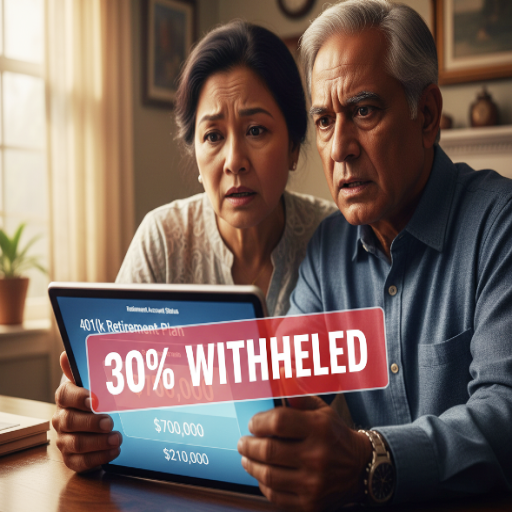
may want to explore topics like [The $700K 401(k) Trap: How Non-Resident
Spouses Must File a 401(k) Retirement Plan](The $700K 401(k) Trap: How
Non-Resident Spouses Must File a 401(k) Retirement Plan).
Nov 30, 2025

Nov 19, 2025

Nov 11, 2025

Nov 11, 2025

Oct 15, 2025
Oct 15, 2025

Comments (0)
Leave a Comment
No comments yet
Be the first to share your thoughts!