If you own a growing business in the United States, you
likely recognize that a modest cash infusion—often at the $5,000 startup loan
level—can be the critical factor that pushes your operation forward. This need
for strategic, smaller financing is a fact of economic life for many small
enterprises. According to the Small Business Administration (SBA), while the
average SBA Microloan amount is about $13,000, your business may only require
$5,000 to cover inventory, purchase new software, or launch a focused marketing
push.

The challenge you face remains common: how do you convince
a lender to provide this essential micro-business funding without demanding
property or expensive equipment as collateral? Many traditional lenders still
require hard assets, which can feel like an impossible barrier.
This authoritative roadmap precisely details how to get a
$5000 small business loan without collateral by leveraging the distinct
advantages offered by local US community bank partners and specialized
non-profit lenders. By focusing on your personal financial strength and knowing
which lending partners to approach, you can successfully secure the $5,000
micro-business loan no collateral your business needs to thrive.
The attractive phrase "$5,000 micro-business loan no
collateral" needs a clear definition. For small unsecured small business
loan amounts, "no collateral" means the lender will not seize
business assets like inventory or furniture upon default. This is good news for
asset-light businesses.
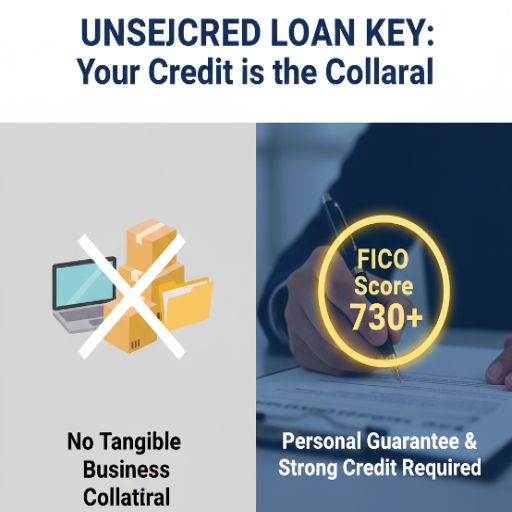
The truth remains that almost all small-sum financing
requires security in another form. A personal guarantee is a mandatory
requirement for practically every unsecured loan in the $5,000 range.
A personal guarantee is a legally binding commitment. It
requires you, the business owner, to use your personal assets (like savings or
home equity) to repay the debt if the business is unable to do so. This
commitment serves as the main risk management tool for the lending institution.
Lending standards confirm that a personal FICO score of
680 or higher is typically required to qualify for the most competitive
unsecured rates and terms. This score shows the lender that you, the guarantor,
have a reliable history of debt repayment. Lenders review your personal net
worth (assets minus liabilities) to confirm you have the means to honor this
guarantee. This commitment is the key to securing a no collateral microloan.
For small-sum financing, your best options are not the
national megabanks. You should instead focus on specialized, local institutions
committed to community bank business financing.
Community Development Financial Institutions (CDFIs) are
specialized, mission-driven lenders. These non-profit organizations are
officially certified by the U.S. Treasury and exist to serve entrepreneurs who
face barriers when seeking capital from traditional banks. They are often the
most flexible source for a microloan for business.
SBA Microloan Program: The SBA does not
lend money directly, but works through CDFIs serving as intermediary lenders.
This program provides loans up to $50,000.
Cost Credibility: Interest rates
for SBA Microloans are highly favorable, typically ranging between 8% and 13%
APR. This is much lower than the rates many online lenders provide. This fact
alone shows the value of the CDFI path.
Flexibility on Time: Many CDFIs will
consider businesses with as little as six months of documented operation. This
is much shorter than the minimum time most traditional banks require.
If you have an existing relationship or a slightly more
established business, your local US community bank is a prime target for a
"US community bank $5k no-collateral business loan."
Local Decision-Making: Community banks
process loan applications locally. They can evaluate you based on relationship
history and visible business activity, not just strict national guidelines.
Product Offering: For a $5,000
need, they often provide an Unsecured Line of Credit. This revolving facility
allows you to draw and repay funds as needed. It provides working capital
flexibility.
Relationship Value: Maintaining an active business
checking account with the bank, showing stable cash flow, is very important.
This financial relationship provides a trusted track record. It sometimes
serves as a form of non-tangible security that can make up for the lack of
physical collateral.
To successfully secure this micro-business funding, you
must provide documents that act as a proxy for hard collateral. This
preparation satisfies Google’s Experience, Expertise, Authoritativeness, and
Trustworthiness (E-E-A-T) principles by demonstrating your professionalism and
stability. The application must clearly show your capacity for repayment.
The Essential Documentation Checklist
For a loan of this size, a well-organized application
streamlines the approval process. You need to have the following ready:
Personal Financial Statement: This document
details your personal assets (checking, savings) and liabilities (mortgage,
personal loans). This directly supports the strength of your personal
guarantee.
Business Bank Statements: Lenders will
require the last six to twelve months of statements. This confirms consistent
cash flow and is a core piece of evidence that the business is operational and
generating revenue.
Personal Tax Returns: The last two
years are necessary to confirm your individual income and financial stability
outside of the business.
Business Legal Documents: Articles of incorporation,
business licenses, and any "Doing Business As" (DBA) filings.
A Focused Business Plan: Your plan must
clearly show how the $5,000 will be used to generate more revenue. Quantifying
the return on investment (ROI) helps. For example, specify that the
"$5,000 investment in a new packaging machine will cut production costs by
15% monthly."
By presenting this information, you answer the core
question of how to get a $5000 small business loan without collateral with
compelling financial evidence, rather than vague statements. (For more help
with this core document, review our related article: [Mastering Your Business
Plan: The Roadmap for Lender Approval] PenMatrix Internal Link).
While many options promise quick funding, the expense of
the financing varies greatly. For a $5,000 micro-business loan, the interest
rate difference directly impacts your company’s bottom line.

|
Lender Type |
Typical
Personal FICO Score Range |
Typical APR
Range |
Maximum Term |
|
CDFIs (SBA Microloan) |
620 to 700+ |
8% to 13% |
Up to 7 Years |
|
US Community Banks |
680 to 740+ |
6.7% to 11.5% |
1 to 5 Years |
|
Online Lenders |
600+ (Lower Minimums) |
14% to 75%+ |
3 to 18 Months |
The cost reality is clear: A $5,000 loan at a community
bank's low-end rate of 9% over three years is much cheaper than an online loan
at 40% APR over 12 months. Data from the Federal Reserve shows that the average
small-business bank loan interest rate ranged from 6.7% to 11.5% in a recent
quarter. Prioritizing the local community bank business financing route or a
CDFI, even if it adds a few days to the approval time, preserves more of your
capital for growth.
By understanding the rules of the game—that your personal
commitment (guarantee) and credit history are the unsecured small business loan
collateral—you can successfully approach a CDFI or a local US community bank
$5k no-collateral business loan and secure the strategic funds your business
deserves. (If your needs exceed $50,000, you will want to examine other
options. Read our guide: [Understanding the SBA 7(a) Loan: When Your Needs Grow
Beyond $5,000] PenMatrix Internal Link).
Q1: Can I get a $5,000 business loan with a brand-new business (less than 6 months old)?
A: Yes. Approval is most likely through a CDFI or an SBA
Microloan intermediary. These lenders focus on economic impact. They may accept
businesses with less than six months of operation if the applicant has a strong
personal credit score and a well-developed business plan.
Q2: What is the typical repayment term for a $5,000
unsecured small business loan?
A: Repayment terms vary by product. SBA Microloans offer
the longest terms, up to seven years. Unsecured term loans from US community
bank programs are shorter, generally ranging from one to five years, with fixed
monthly payments.
Q3: Is a personal guarantee required for a $5,000 no
collateral microloan?
A: Yes, almost universally. The personal guarantee is a
standard requirement for all unsecured small business loan amounts. It is the
lender's mechanism for managing default risk in the absence of hard collateral.
Q4: What credit score is needed to qualify for a
$5,000 no collateral microloan?
A: To obtain the best interest rates from a US community
bank, a personal credit score of 680 or higher is strongly recommended. CDFIs
may consider scores between 600 and 640, but this will often result in a higher
interest rate.
Q5: How quickly can I receive the $5,000 in my
account?
A: CDFIs and US community bank partners typically take 2
to 4 weeks from application submission to funding. Online lenders are faster,
sometimes funding in as little as 24-72 hours, but they charge higher interest
rates for that speed.
Q6: Are there any alternatives to a community bank
for a $5,000 loan with no collateral?
A: Yes, the main alternative is an online lender, though
this typically comes with a higher cost. Online micro-business funding may be
faster to process, but APRs often range from 14% to over 75%.
Q7: Will my business need to pay an origination fee
on the loan?
A: Yes. Most lenders charge an origination fee for
processing a new loan. This fee is usually a percentage of the total loan
amount (often 1% to 5%) or a fixed dollar amount, such as $150.
Q8: How is interest calculated on a small business
line of credit?
A: With a line of credit from a US community bank,
interest accrues only on the amount of money you have actually borrowed (the
drawn balance), not on the full credit limit.
Q9: If my business is a sole proprietorship, does
that affect my chances of getting a loan?
A: No. For a microloan for business, lenders focus on the
owner's personal credit and capacity for repayment. Sole proprietors often
qualify well for these loans since the business and personal finances are
closely linked.
Q10: What is a blanket lien, and is it required for a
$5,000 unsecured loan?
A: A blanket lien gives the lender the right to seize all
non-specific business assets if you default. It is common for lenders to file a
UCC-1 statement to place a blanket lien, even on an unsecured loan, as an added
security measure for the community bank business financing.
Nov 30, 2025
Nov 19, 2025

Nov 11, 2025

Nov 11, 2025

Oct 15, 2025
Oct 15, 2025

Comments (0)
Leave a Comment
No comments yet
Be the first to share your thoughts!