
Are you
a tax-aware American investor looking for the safest place to park your cash without losing value to
inflation? If your savings are
sitting in a High-Yield Savings Account
(HYSA), you are likely
leaving thousands of dollars on the table for state and local tax authorities
to claim. With top HYSAs currently offering Annual Percentage Yields (APYs) up
to 5.00%, this option may seem like the best path for liquidity and return.
But for you, and millions of Americans, particularly those residing in
high-tax states, that seemingly attractive APY is an illusion. The silent
financial shift that is reorganizing short-term
investment strategies is the realization that the tax code has created a
massive investment loophole that makes a U.S. government debt instrument—the
Treasury Bill (T-Bill)—the superior choice for maximizing your after-tax returns.
Well,
you are an investor in a
high-tax state like California (with a top marginal state income tax rate near
9.3%). A competitive HYSA offering a 4.40% APY actually delivers an after-tax
return of approximately 2.93%
when combined with a 24% federal bracket. By contrast, a 4-week Treasury Bill (T-Bill), with a yield
of approximately 4.09%, delivers an after-tax return of 3.11%. In this common scenario, the lower-yielding T-Bill
instantly becomes the superior choice for
your net gain.
This slight-but-significant margin
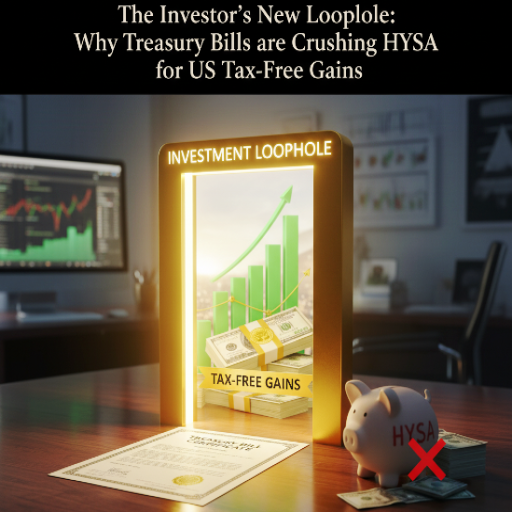
is the heart of the Tax-Free Gains
Investment Loophole. While the gross yield of a Treasury Bills vs HYSA USA Tax is often neck-and-neck, the federal
debt instrument carries a decisive, legally mandated tax advantage—it offers tax-free gains US Treasury Bills at
the state and local level. This exemption is the invisible lever that allows T-Bills crushing high-yield savings accounts
once your tax bill arrives.
A High-Yield Savings Account alternative is needed because HYSA
interest is treated as ordinary taxable
fixed-income. This means every dollar you earn is subject to taxation at both the federal and
state/local levels. This also applies to the interest portion of certain short-duration
bonds and most traditional bank products. For those considering 5 Safe Alternatives to the Stock Market for
Short-Term Cash, understanding the tax implications is valuable for your financial plan.

In states with no income tax, this
isn't a major issue, but the United States includes residents of states with
high income tax rates, such as New York, California, and Massachusetts. For
these individuals, a 5.00% HYSA APY must be reduced by both a federal levy
(which can exceed 30% depending on your
bracket) and a state/local levy (which can exceed 10%). The result is a
substantial drop in the true, usable return.
The HYSA is a liquid, FDIC-insured
product, but its full taxability makes it less efficient for wealth
preservation compared to its government-backed counterpart.
Treasury
Bills are short-term government debt obligations (with maturities
typically ranging from 4 to 52 weeks) that are sold at a discount to their face
value. The comparison between Treasury
Bills vs HYSA USA Tax hinges entirely on the interest earned. The
return—the difference between the discounted purchase price and the face value
paid at maturity—is the interest earned. For a thorough primer on all federal
securities, see The Complete Guide to
Understanding US Treasury Securities [Internal Link: The Complete Guide
to Understanding US Treasury Securities].
The key tax advantage stems from the Constitutional immunity doctrine. As a debt instrument of the federal
government, the interest earned on T-Bills is generally exempt from all state
and local income taxes—a direct benefit
to your pocket. The official stance is confirmed by the U.S. Treasury,
which explicitly states that interest is exempt from state and local taxes, a foundational tax-planning tool you should
use Source: Treasury Bills - TreasuryDirect.
This state and local tax exemption transforms the competitive
landscape, making it a powerful investment loophole that allows you to legally shield a portion of your income from state tax
authorities.
To accurately compare a fully
taxable HYSA to a state-tax-exempt T-Bill, you must use the Tax
Equivalent Yield (TEY) calculation. This formula answers the question: What
APY would a fully-taxable investment need to offer to match your after-tax return of the
state-tax-exempt T-Bill?
We can prove how a T-Bill, despite a
lower posted yield, often generates a superior after-tax return, thus
justifying why T-Bills are crushing
high-yield savings accounts.
Example:
TEY
= {(T-Bill After) – (Federal Tax Yield)}/{(1 – (State Tax Rate)}
= 3.11%/(1 – 0.093)
= 3.11%/0.907
= 3.43%
This result means that the 4.09%
T-Bill provides the same after-tax cash flow as a fully taxable investment
(like a HYSA) yielding 3.43% APY.
The TEY advantage only grows more
dramatic in states with high marginal income tax rates. You should look up your state's top bracket to determine the full
value of this exemption.
Beyond the tax arbitrage, T-Bills
offer two main features crucial
for your short-term investment
strategies and cash management: safety
and liquidity. This provides a
sophisticated answer to the Treasury
Bills vs HYSA USA Tax dilemma. The yields of both T-Bills and
competitive HYSAs are heavily influenced by the Federal Reserve's interest rate policy, making them responsive to
current market conditions.

1.
Zero
Default Risk: Treasury Bills carry the unconditional guarantee of the United
States government. This makes them virtually the safest investment in the
world, often considered lower risk than even FDIC-insured HYSAs in the event of
an extraordinary market crisis.
2.
Liquidity
and Interest Rate Risk: While you must hold a T-Bill until maturity (e.g., 4, 8, 13 weeks) to
realize the full stated return, they are highly liquid and can be sold easily
on the secondary bond market before maturity. However, you should be aware of the inherent interest rate risk: should prevailing market rates increase after you have bought your T-Bill, its secondary market
value will decrease. This means selling before maturity could lead to a capital
loss. This is a risk that money market funds (MMFs) and short-duration bonds also face.
1.
Directly
via TreasuryDirect: This is the government's official
platform and the easiest way to ensure you
avoid unnecessary fees. You
purchase T-Bills directly at auction. At the end of the tax year,
TreasuryDirect will automatically generate Form 1099-INT, which clearly
separates the interest earned on U.S. government obligations, simplifying your state tax filing process.
2.
Through a
Brokerage Account: Most major brokerage firms (like
Fidelity or Vanguard) offer T-Bills. The benefit is convenience, as you can hold all your investments in one place.
However, the brokerage's Form 1099-INT may not automatically segregate the U.S.
government interest. You may
need to reference supplementary statements or the firm's website to find the
exact amount of U.S. Treasury income that is exempt from your state tax.

In the current environment where federal vs state taxation creates an
unequal playing field, T-Bills are the clear winner for tax efficiency. They
are not just an investment for institutional portfolios; they are a
sophisticated short-term investment
strategy you can immediately use for every tax-aware US investor.
Q1: Are Treasury Bills completely
tax-free?
A:
No. All earnings generated by Treasury
Bills remain liable for federal
income taxation. The main
advantage is that the interest is exempt from all state and local income taxes,
which results in significantly higher after-tax gains, especially for
residents of high-tax states.
Q2:
How does the risk of a T-Bill compare to an HYSA?
A:
Both are considered extremely safe. A High-Yield Savings Account is protected
by FDIC insurance up to $250,000. T-Bills
carry the ultimate backing of the federal government, giving them essentially a
zero default risk, regardless of the investment amount.
Q3:
What is the Tax Equivalent Yield (TEY)?
A:
The TEY is a metric used to compare the return of a tax-exempt investment (like
a T-Bill) to a fully taxable investment (like a HYSA). It shows what a
fully-taxable investment would need to yield to match the after-tax return of
the tax-exempt investment, providing a clearer view of which option truly
provides the most cash in your
pocket.
Q4:
Do I need a brokerage account to buy T-Bills?
A:
No. You can buy new-issue
T-Bills directly from the U.S. government using a TreasuryDirect account, which
allows you to bypass brokerage
fees. You can also purchase them
through most major brokerage firms.
Q5:
Do all states honor the T-Bill tax exemption?
A:
Yes. The exemption of interest earned on U.S. government obligations from state
and local income taxes is required by federal law and upheld in all 50 states.
Q6:
What is the minimum investment for T-Bills?
A:
The minimum purchase amount for Treasury Bills is $100. They are sold in
increments of $100. This makes them highly accessible to small investors.
Q7:
Are T-Bills affected by inflation?
A:
The value of a T-Bill is not directly adjusted for inflation. Inflation can
erode the purchasing power of your
return, but T-Bills are a hedge against inflation risk when compared to
traditional savings accounts, as their yield generally moves with the Federal
Reserve's rate adjustments.
Q8:
What is the difference between a T-Bill and a T-Bond?
A:
The main difference is the maturity date. T-Bills are short-term securities (up
to 52 weeks). T-Bonds are long-term securities with maturities of 20 or 30
years, and they pay interest every six months.
Q9:
Is T-Bill capital gain/loss subject to state tax?
A:
Yes. If you sell a T-Bill on the
secondary market before maturity and realize a capital gain or loss, that gain
or loss is typically subject to state and local capital gains taxes, as the
exemption only applies to the interest income portion.
Q10:
Can I use T-Bills for my emergency fund?
A:
T-Bills are excellent for emergency funds because they are safe and highly
liquid. However, you should
align the T-Bill's maturity (e.g., 4-week or 8-week) with your need for cash. For cash needed immediately,
an HYSA is often better.

Nov 30, 2025

Nov 19, 2025

Nov 11, 2025

Nov 11, 2025

Oct 15, 2025
Oct 15, 2025


Comments (0)
Leave a Comment
No comments yet
Be the first to share your thoughts!