
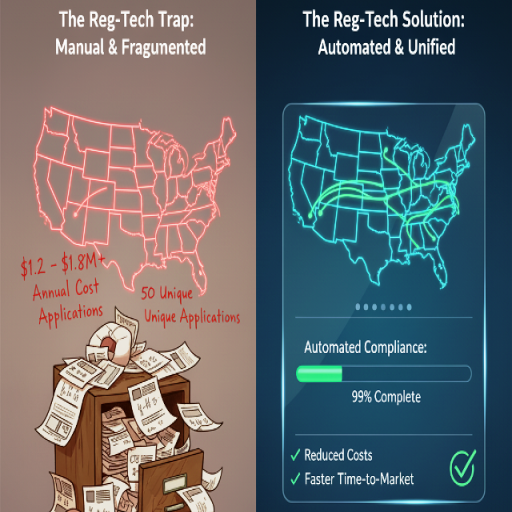
If
you’re building a FinTech start-up in the United States, licensing feels like a
slow leak draining momentum. We’ve watched founders design
brilliant payment products—only to lose a year dealing with paperwork. What
looks like one application quickly turns into fifty unique ones, each with its
own fees, bonds, and deadlines. The truth is clear: in American finance,
compliance is not optional, and it is never inexpensive.
Every
FinTech offering payments, remittances, or wallet services must hold a Money
Transmitter License (MTL) in each state of operation. There is no single
federal fast track. Each state regulator sets its own interpretation of “money
transmission,” its own surety bond requirements, and its own renewal process.
As
of the 2026 outlook, a full multi-state deployment typically costs US $1.2 –
1.8 million and takes around 15–24 months. The real cost extends far past the
official regulator fees, driven mainly by ongoing operational expense.
Application
fees: US $250 – 10 000+ per state
Surety
bonds: US $50 000 – 1 000 000, connected to transaction volume
Annual
renewals: US $250 – 1 500
Operational
overhead: Compliance staffing (e.g., $100k+ annual salary for a dedicated
compliance officer), audit fees, and specialized AML/KYC technology
subscriptions
Even
a 10-state launch can require US $200 000 – 350 000 before a single transaction
is processed, with much of that money tied up in bonds and legal fees that do
not generate revenue.

The
table below presents an updated picture of licensing burdens in important
jurisdictions. Remember that capital (net worth) requirements, which vary by
state, must also be maintained and represent a major hidden expense.
|
State |
Application Fee |
Surety Bond Range |
Net Worth Requirement |
Typical Approval Time |
|
California |
US
$5 000 |
US
$250 000 – 1 000 000 |
Varies,
minimum $250,000 |
9
– 18 months |
|
New
York |
US
$3 000 |
US
$500 000 – 1 000 000 |
Varies,
minimum $500,000 |
12
– 24 months |
|
Texas |
US
$1 500 |
US
$300 000 – 500 000 |
Varies |
6
– 12 months |
|
Florida |
US
$1 000 |
US
$100 000 – 500 000 |
Varies |
4
– 9 months |
|
Illinois |
US
$1 200 |
US
$250 000 – 750 000 |
Varies |
6
– 10 months |
Sources:
Updated industry estimates, NMLS, and state regulator filings (2026 outlook)
Consider
a start-up from Austin expanding to twenty states. Between license
applications, surety bonds, and compliance submissions, its first-year cost
tops US $500 000. The product is complete, but funding is stalled. Investors
ask about launch dates; regulators request more documents. Growth stops while
paperwork continues—a textbook case of the Reg-Tech Trap.
Financial
rules in the U.S. remain state-based. Forty-nine states plus Washington D.C.
regulate money transmission—Montana remains the single exception. The
disjointed structure is starting to move toward a more coordinated approach,
mainly because of the Conference of State Bank Supervisors (CSBS).
The
CSBS created the Money Transmission Modernization Act (MTMA) to coordinate key
requirements across the nation. As of mid-2025, over 40 states have enacted the
MTMA fully or in part. Importantly, money transmitters licensed in
MTMA-adopting states collectively perform 99% of all reported money
transmission activity. This coordination, which affects requirements for net
worth, surety bonds, and approved investments, is simplifying operating
complexity.
This
movement explains why many founders still begin in high-value states
first—California, New York, or Texas—but can now plan national expansion with
improved consistency.
(Learn
more in our PenMatrix feature on Open Banking API Rules in the U.S.)
The
noticeable application fees are just one part of the cost. Maintaining licenses
is the dominant expense, often two or three times the statutory costs. This
operational expense includes:
Dedicated
Staffing: Required compliance officers whose salaries often exceed US $100 000
annually.
Technology
& Systems: Annual costs for transaction monitoring, sanctions screening,
and AML platforms, which can cost $20 000–50 000 based on volume.
Audit
Overheads: Required annual financial statement reviews and independent AML
audits, frequently costing $15 000–30 000+.
FinTechs
must commit 10–15 % of operating expenses purely to license maintenance and
oversight. Missing a single renewal notice can lead to suspension or penalties
under 18 U.S.C. § 1960, which makes unlicensed money transmission a crime.
To
handle this cost spiral, FinTechs increasingly use Regulatory Technology
(RegTech) platforms that automate the manual work of monitoring and reporting.
RegTech offers a centralized solution to the fragmented reality of state laws.
Automatic
tracking of changing state rules, including updates from the MTMA.
Centralized
KYC/AML workflows and audit logs, prepared for regulator review.
Real-time
dashboards for managing license renewals and surety bond updates.
Automated
transaction reporting to multiple regulatory bodies (NMLS).
The
global RegTech market was valued at US $12.47 billion in 2023 and is projected
to reach over US $72 billion by 2032, reflecting a Compound Annual Growth Rate
(CAGR) of over 21.6 %. This rapid climb shows how essential automation has
become. The most successful FinTechs in 2026 combine technology accuracy with
regulatory skill, understanding that tools still require human oversight for
rule interpretation and regulator interactions.
Prioritize
MTMA-Adopting States. Begin licensing in the 40+ states that have adopted the
MTMA first. This ensures a more coordinated and predictable initial expansion.
Estimate
total operational expense. Include bonds, yearly renewals, IT systems, and
dedicated compliance staffing from the start.
Build
regulator relationships early. Make use of the MTMA's standardized rules to
simplify initial communication and reduce approval time.
Consider
partnership methods. Some businesses operate under a licensed sponsor before
applying independently, effectively delaying the initial capital commitment.
View
adherence as brand capital. Investors and customers now judge maturity by how
responsibly you manage regulation.
(Related
reading: The Plaid Lie – Data Security in U.S. Open Banking)
The
time for unified licensing is coming. The widespread enactment of the Money
Transmission Modernization Act (MTMA) has been the most important event,
creating consistency in core financial requirements across the U.S. while still
preserving state-level consumer protection.

At
the same time, RegTech companies are expanding cloud-based compliance systems
now feature AI rule monitoring, OCR-based document verification, and warning
systems for renewal risks. Until the final states fully match their rules,
automation remains the quickest, most scalable way to cut complexity and reduce
the operational expense of multi-state compliance.
For
American FinTech founders, licensing is not unnecessary restriction—it’s the
price of credibility. Those who budget early for the full operational cost, use
RegTech wisely, and integrate compliance into their operations gain a
competitive advantage.
“Compliance
isn’t an obstacle to growth—it’s the foundation of trust.”
Plan
your licensing roadmap with the same precision as your product creation.
(Read
more insights in PenMatrix › Digital Banking & Technology)
1. What is a Money Transmitter License (MTL)?
A
state-issued permit allowing a business to transfer or store customer funds.
2. How long does nationwide licensing take in 2026?
Usually
15–24 months, depending on document quality, regulator backlog, and which
states are prioritized.
3. Average per-state cost in 2026?
Between
US $250 and 10 000, plus surety bonds up to US $1 million, and substantial
operational costs.
4. How many states have adopted the MTMA?
Over
40 states have adopted the Money Transmission Modernization Act (MTMA) in full
or in part as of mid-2025.
5. Do crypto firms need separate licenses?
Yes.
Many states treat virtual currency as money transmission, often requiring a
variation of the MTL.
6. Which state does not require a license?
Montana
is currently the only exception.
7. What happens if I operate without a license?
Violations
can trigger fines, cease-and-desist orders, and criminal prosecution under 18
U.S.C. § 1960.
8. How big is the global RegTech market?
The
market was valued at over US $12 billion in 2023 and is projected to reach over
US $72 billion by 2032.
9. Are surety bonds refundable?
The
bond itself is financial protection, not a fee. Unused premiums paid to the
surety company may be returned when licenses are surrendered, but the annual
fee is a sunk cost.
10. What’s the most efficient entry strategy?
Begin
with high-value states, use RegTech early to manage overhead, and scale
progressively leveraging the MTMA standards.
Nov 30, 2025

Nov 19, 2025

Nov 11, 2025

Nov 11, 2025

Oct 15, 2025

Oct 15, 2025


Comments (0)
Leave a Comment
No comments yet
Be the first to share your thoughts!